What a multi-PAC application is
For a CFDI to be valid, an Authorized Certification Provider (PAC) must stamp it. A PAC is a company authorized by the SAT to validate the invoice, assign its fiscal folio (UUID) and deliver a copy to the tax authority.
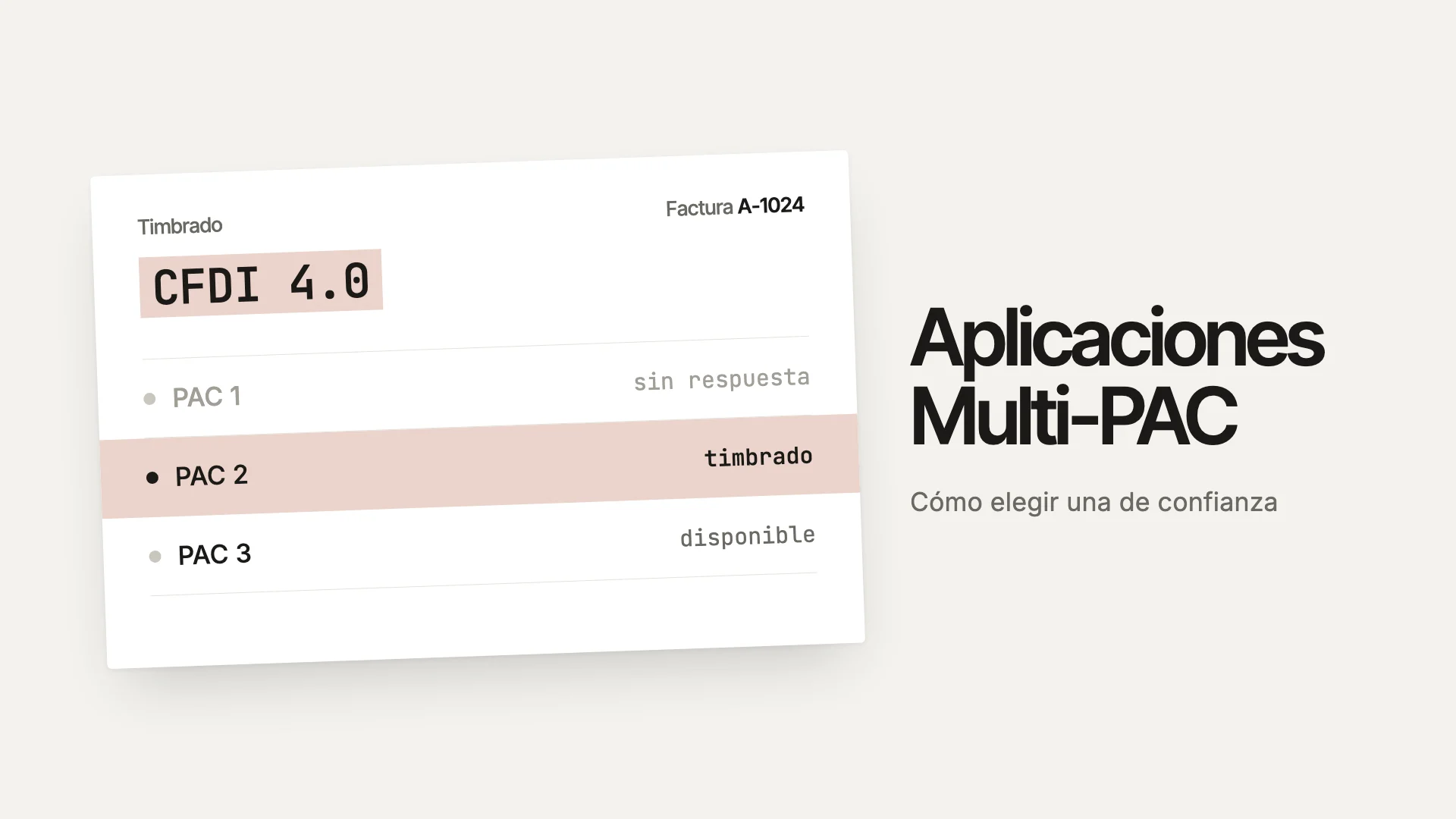
There are two ways to invoice. The first is to use the system of a PAC, which stamps under its own authorization. The second is to use a multi-PAC application: an invoicing system connected to several PACs that sends each invoice to whichever one is available.
In both cases you receive the same CFDI, with the same validity before the SAT. What changes is who you depend on to keep invoicing. The technical detail of switching between PACs is in PAC vs Multi-PAC: electronic invoicing architecture.
Advantages of the multi-PAC model
The advantages come from not depending on a single certification provider.
- Continuity. PACs have outages, like any online service. If one does not respond, the application stamps with another and you keep invoicing.
- Lower regulatory risk. The SAT can revoke the authorization of a PAC. With a single PAC, that forces you to change systems urgently. With several, the application stops using that PAC and your operation stays the same.
- Focus on the system. The company that operates the application is dedicated to the software you use every day: data entry, catalogs, collections, reports and support.
- One price. You pay per stamp or per plan, regardless of which PAC stamped each invoice.
Disadvantages and risks you should know
The model also has costs. It is worth knowing them before you sign up.
- There is one more intermediary. Between you and the PAC stands the company that operates the application. If that company fails, it matters little that its PACs work.
- The SAT does not supervise the application. The authorization, the reviews and the guarantee required by the SAT apply to the PAC. Nobody certifies the application, so the review is up to you.
- The term is not regulated. Any system can advertise itself as multi-PAC. Some stamp with a single PAC, or switch to another manually, when someone on their team notices the failure.
- Your Digital Seal Certificate is in the hands of the application. To seal your invoices, the system stores your CSD and its password. That custody depends on the company that operates the application.
Architecture: what to ask
You do not need to be an engineer to evaluate the architecture. It is enough for the provider to answer specific questions in writing.
- How many authorized PACs does it stamp with? With only one, it is not multi-PAC.
- Is switching PACs automatic? It should happen in seconds and without any action from you. If it depends on someone activating it, you will spend hours without invoicing.
- Where is the infrastructure? A serious provider states which cloud it runs on and since when.
- How is your CSD stored? Ask whether the password is stored encrypted and who has access.
- Can you take your information out? You should be able to download your XML files and your catalogs at any time.
Experience: how to verify how many years it has been operating
Electronic invoicing in Mexico changes often. In two decades it went from the CFD to the CFDI and through versions 3.2, 3.3 and 4.0, each with new complements, catalogs and cancellation rules. A provider that has been through those changes knows what the next one involves.
Anyone can write "years of experience" on a website. These facts can be verified:
- Legal name and RFC. They should appear in the terms and conditions and in the privacy notice. With the legal name you can look up when the company was incorporated.
- Domain age. A WHOIS lookup shows the date on which its web address was registered.
- Archived versions of the site. At web.archive.org you can see what its website looked like five or ten years ago, or confirm that it did not exist.
- Named customers. Ask for references or look for published cases of real companies that have been with that provider for years.
- Address and phone number. An established company publishes where it is located and answers when you call.
Transparency: what a serious company publishes
A company that intends to stay in the market publishes the information you need to hold it accountable.
- Visible pricing. The price table is on the site, with what each package includes and what is charged separately.
- Who it is. Legal name, address and contact channels, without a form being the only way in.
- Clear rules. Current terms and conditions and privacy notice, under the same legal name.
- Public documentation. If it offers an API, the documentation can be read without requesting a demo.
- Support from people. Someone who knows the product answers you, through a channel you can test before you buy.
Recently created companies and software built with artificial intelligence
Today a single person can publish an invoicing application in a few weeks, using artificial intelligence tools that write the code. Many have appeared in recent years, with well-designed websites and low prices.
Artificial intelligence is a programming tool, and experienced engineering teams use it too. The risk appears when there are no software engineers behind the system who understand what was built and answer for it.
In invoicing, that backing is tested at specific moments:
- The SAT publishes a change to Annex 20 or to a complement, and it has to be adapted and tested before it takes effect.
- A cancellation stays in process or an invoice is stamped twice, and someone has to review what happened with that fiscal folio.
- There is a security incident, and the company has to know which data and which certificates were exposed.
- Volume grows at month end, and the system has to respond the same way.
Warning signs before you sign up
One of these signs alone does not rule out a provider. Several together justify looking for another option.
- There is no way to verify since when it has operated: no legal name, no domain history and no named customers.
- No responsible person or company appears, and no address.
- Support is only an automated chat and there is no way to talk to someone.
- There is no technical documentation, no changelog and no notices when the SAT changes a rule.
- The site promises a lot and specifies little: no complete pricing, no limits and no terms.
- They do not answer the architecture questions in this guide in writing.
Checklist for comparing providers
Send these questions to each provider you are evaluating and compare the answers.
- How many PACs authorized by the SAT do you stamp with?
- Is switching PACs automatic when one fails?
- What infrastructure do you run on and since what year?
- How do you store my CSD and its password?
- Can I download all my XML files whenever I want?
- What is your legal name and in what year was the company incorporated?
- Since which version of the tax invoice have you operated?
- Who develops and maintains the system? Do you have your own software engineers?
- Where are your complete prices and your terms published?
- Who helps me if a stamping or a cancellation fails, and through which channel?
How Factura Digital answers
Factura Digital is a multi-PAC application. It stamps with PACs authorized by the SAT and, if one does not respond, your CFDI still gets stamped, with nothing for you to do.
We have operated since 2008, when the invoice was the CFD, and we have been through every version of the CFDI up to 4.0. In that time, more than 1 billion documents have been issued on the platform. The infrastructure has been on AWS since 2015 and today runs on AWS and Google Cloud.
The company is Novatech Digital S.A. de C.V., based in Monterrey, Nuevo León. Pricing is published, stamps never expire and the API documentation is public. The system is developed and maintained by an in-house engineering team, and support is provided by people. Your XML and PDF files can be downloaded whenever you want, one by one or as a ZIP.
You can create your account with 10 free stamps, no card required, and run your own tests. If you already invoice with another provider, read how to switch invoicing systems without losing your CFDIs.